Water Clock

Mary Mattingly

Videos

Histoire orale

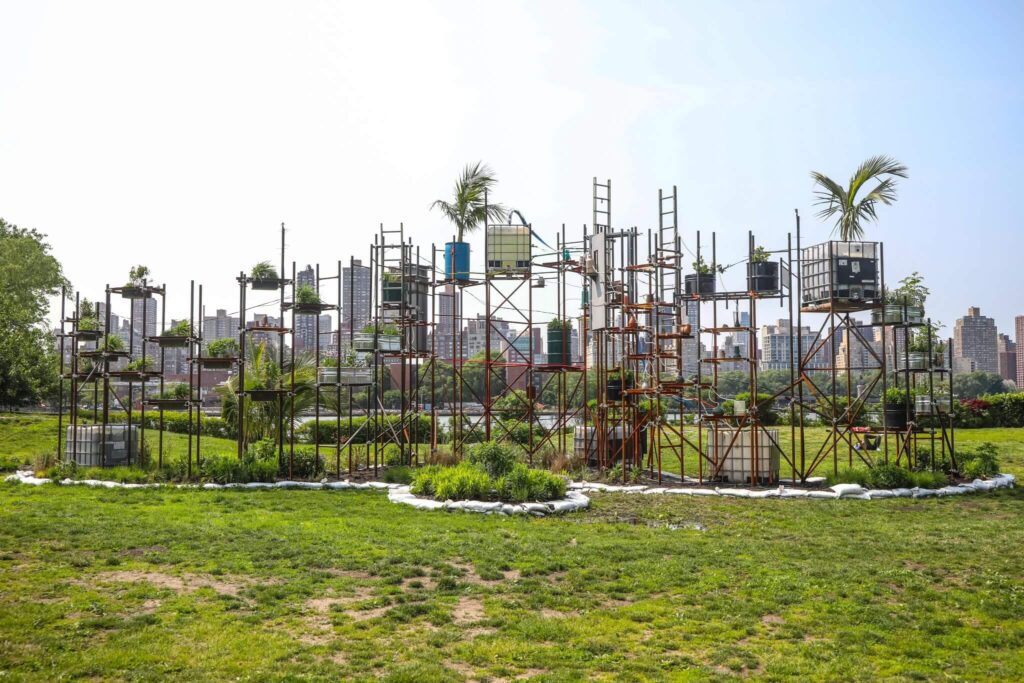
Mary Mattingly discusses her exhibition Ebb of a Spring Tide and Water Clock

Unable to load audio

Topics

00:50 — 01:30
02:02 — 04:10

Mary Mattingly: Flock House is a project I started in 2012, small spheres or habitats that plug into existing infrastructure. Often times utilizing excess from the surrounding buildings. They had portable gardens, solar units, and everything to make a small modular system habitable. I imagine that they would be more and more relevant with the displacement due to weather events, desertification, and rising sea levels as cities would begin to operate more informally. Sharing resources like energy systems and water collection systems. While I grew up on the East Coast, I’ve lived all over the country and beyond. And these itinerant Flock Houses structures felt especially relevant to me, as I often carried around my possessions – which are such a weight, sometimes – to another temporary dwelling, for work or for a residency, always returning to home in New York.

The flock house felt like home again after I moved from the flooding apartment and searched for a new home in a city with rising rents and a dearth of available units. This summer I will inhabit the flock house at different times, and use it as a studio. In part, I’ll work on photographic project, experimenting with a dye garden and a photographic garden for help developing black and white prints. Please join me later in the summer, for photographic workshops.
Hide Transcript

Mary Mattingly Discusses flock house

Unable to load audio

Topics

01:34
03:04

Mary Mattingly: Flock House is a project I started in 2012, small spheres or habitats that plug into existing infrastructure. Often times utilizing excess from the surrounding buildings. They had portable gardens, solar units, and everything to make a small modular system habitable. I imagine that they would be more and more relevant with the displacement due to weather events, desertification, and rising sea levels as cities would begin to operate more informally. Sharing resources like energy systems and water collection systems. While I grew up on the East Coast, I’ve lived all over the country and beyond. And these itinerant Flock Houses structures felt especially relevant to me, as I often carried around my possessions – which are such a weight, sometimes – to another temporary dwelling, for work or for a residency, always returning to home in New York.

The flock house felt like home again after I moved from the flooding apartment and searched for a new home in a city with rising rents and a dearth of available units. This summer I will inhabit the flock house at different times, and use it as a studio. In part, I’ll work on photographic project, experimenting with a dye garden and a photographic garden for help developing black and white prints. Please join me later in the summer, for photographic workshops.
Hide Transcript

Artistes de cette exposition